Acreage & Taxes: Smart Things to Know About Owning Land in Myakka City
Published September 23, 2026 · By Roger Reed
Buying acreage in Myakka City is a different financial conversation than buying a lot in a subdivision, and taxes are a big part of the reason. Florida's tax structure, the state's agricultural assessment rules, and homestead protections all shape what it actually costs to own land here over the long run. This article explains the basics in plain English; it is not tax advice, and your specific numbers should come from a CPA and the Manatee County Property Appraiser.
No State Income Tax: The First Big Difference
Florida has no state personal income tax, which is one of the first things out-of-state buyers notice. There is no state tax on wages, salaries, or most retirement income, and that is a recurring, year-after-year difference versus many northern and western states. It is not the whole tax picture, though: Florida does collect property taxes, sales tax, and taxes on some business activities, so the saving shows up in your income, not in every bill.
The Greenbelt Law: What Agricultural Classification Actually Requires
The single most important acreage-specific rule in Florida is the Greenbelt Law, Florida Statute 193.461. It allows land in bona fide commercial agricultural use to be assessed at its agricultural use value instead of its highest-and-best-use market value. For a large parcel in a growing area, that can mean a dramatically lower assessment, because the county values what the land produces, not what a developer might someday pay for it.
How does the classification work in practice?
- It is an application and classification process, not an automatic exemption. Agricultural use must be real: cattle, horses, hay, timber, beekeeping, nurseries, and other accepted operations all count when they are conducted in good faith as commercial agriculture.
- An application must be filed on or before March 1 each year, and the land must genuinely be in agricultural use as of January 1 of that year.
- The property appraiser inspects and can reclassify the land if it is diverted to nonagricultural use. It is reviewed annually, and the residence and its immediate curtilage are assessed separately from the agricultural land.
This matters to many Myakka City buyers because large parcels here are often already working pasture or timberland. Whether a specific property qualifies is a factual question for the appraiser, not a guess anyone should make at a listing table.
Homestead Exemption and Save Our Homes
Floridians who make their acreage their permanent home qualify for the homestead exemption. For owner-occupied primary residences, Florida allows up to $50,000 off the assessed value: the first $25,000 is exempt from all property taxes, including school taxes, and an additional $25,000 on the assessed value between $50,000 and $75,000 is exempt from non-school taxes. Applications are filed with the property appraiser, generally by March 1.
Once homesteaded, the Save Our Homes amendment caps annual increases in assessed value at 3% or the rate of inflation, whichever is lower, which protects long-term owners from sharp swings. There is a bonus for people already homesteaded elsewhere in Florida: Save Our Homes portability lets you transfer up to $500,000 of the accumulated benefit to a new homestead, as long as you establish the new homestead within the required timeframe after abandoning the old one.
Agricultural Sales-Tax Exemptions
For buyers who will actually farm or ranch the land, Florida's Department of Revenue provides sales-tax exemptions on many purchases used directly in agricultural production, such as feed, seed, fertilizer and certain farm equipment. The exemptions require registration and documentation, and eligibility depends on the operation. A knowledgeable local CPA who handles farm clients is the right person to walk you through what qualifies in your specific setup.
The No-HOA Angle on This Property
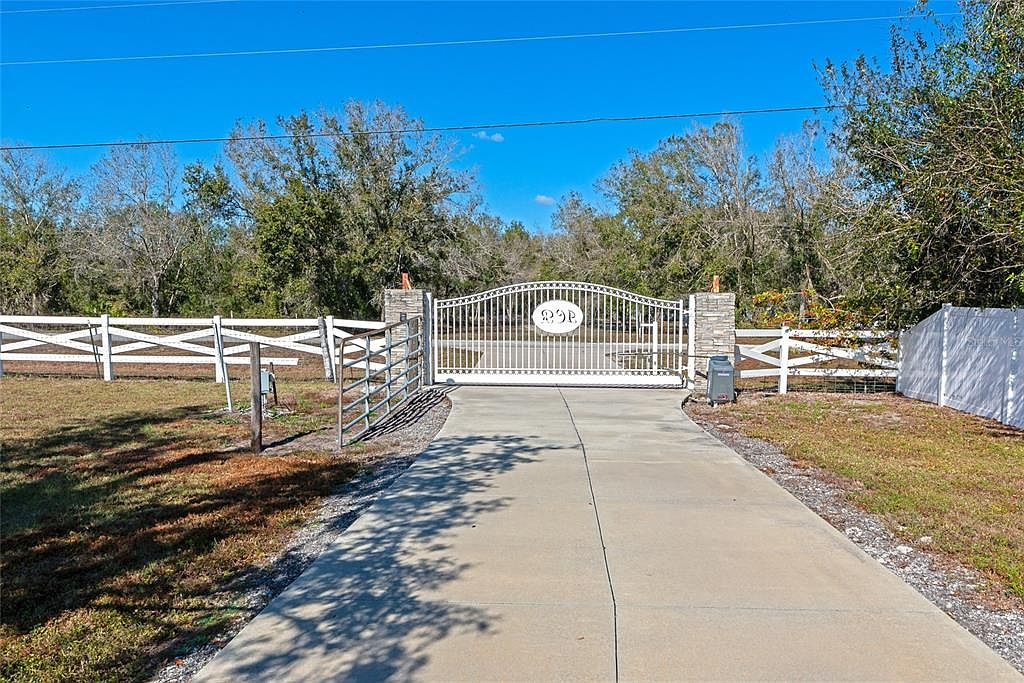
28154 Gopher Hill Rd has no HOA, which pairs naturally with an acreage focus: no monthly association fees, and room for horses, farm buildings, workshops, or a home business, subject to county zoning and permitting for your intended use. The property already reflects that pattern with three buildings on more than five acres, a commercial-grade gym and executive office in the second structure, and flex space in the third. You are not paying an association to let you pursue a rural lifestyle; the county is the only landlord that matters.
Your Next Step
Here is the honest bottom line: exact assessments, classifications, and tax ranges are set by the Manatee County Property Appraiser and depend entirely on how the land is actually used. No one should commit to a purchase assuming a specific tax bill. The practical next step is to talk it through: visit the Manatee County Property Appraiser for current assessment rules and parcel records, and run the ownership scenario past a CPA who knows Florida agriculture. The Greenbelt, homestead and portability tools are powerful; they are also detail-dependent, which is exactly why they reward planning.
Did you know about the Greenbelt classification before reading this? It is the kind of detail that quietly makes estate living in Myakka City more affordable than its coastline reputation suggests, and it is worth understanding before you make the move.
Run the Numbers
Want to Talk Through What Estate Ownership Looks Like Here?
Roger Reed can show you the property and connect you with the local professionals who handle assessments and tax planning. Use the contact form, call, or email.
Related: interested in what no HOA changes about ownership? Read what no HOA really means, or start with what's within 10 miles of the property.
This article is educational and is not tax, legal, or financial advice. Sources: Florida Statute 193.461, Florida Department of Revenue publications (including Save Our Homes portability and homestead exemption guides), and the Manatee County Property Appraiser. Exact exemptions and classifications depend on individual circumstances; verify with a qualified professional.